Showing posts with label 2011. Show all posts
Thursday, November 07, 2013
Paddle to the Amazon
In June of 1980, Don Starkell and his teenaged-son Dana embarked on an adventure they had been planning for years: to canoe from Winnipeg, in the middle of the Canadian prairie, to the mouth of the Amazon River in Brazil. Even after finishing Don's book, it still sounds like a crazy idea. Paddle the Red River upstream from Winnipeg, portage to the Mississippi River system, down the Mississippi into the Gulf of Mexico, around the Gulf and down the coast of Central and south America, then up the Orinoco River into the heart of Venezuela, then back down the Rio Negro and the Amazon to the sea.
2 years. 12,000 miles. 20,000,000 paddle strokes.
Yet somehow, they pulled it off. Between the arduous paddling, the over-zealous soldiers and policía, terrible weather, and bouts of near-starvation and intestinal upsets, Don and Dana somehow survive, not always because of Don's skill as an expedition leader (or some may say lack thereof), but often only thanks to the kindness and generosity of some of the poorest people on the planet.
Don's diary is a classic story of adventure and survival against insane odds. Well worth checking out.
Sunday, October 13, 2013
Sea Kayak with Gordon Brown - Volume 2
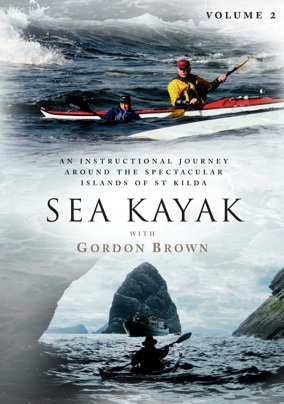
The second volume of Sea Kayak with Gordon Brown recently arrived in the mailbox, and has been taken for a spin on the DVD player. Like the first volume, the DVD is really two films in one -- one features Gordon taking a group of kayakers around the Scottish Islands of St. Lida, the second features Gordon demonstrating rescue and towing techniques. You can also watch the expedition and the lesson section separately as independent features, or as one long film.
The expedition portion takes us to the islands of St. Kilda, a small group of islands forty miles of the coast of northern Scotland. Here, Gordon and his group tour an amazing group of islands and stunning stacks, caves and channels. It’s a stunningly beautiful area, and clearly made to be explored by kayaks.
The lesson portion demonstrates rescue techniques, both solo and assisted, as well as towing techniques and even a few balance exercises, demonstrated in both calm and rough waters. These lessons are excellently presented and easy to follow (although it must be said that Brown’s brogue occasionally left some in our viewing group asking the others “what did he say?” I didn’t have that issue. Your mileage may vary.) The towing lessons were full of ideas that we’re eager to try next time we have a practice session, and the importance of practicing is brought home by a couple of unplanned tip-overs and tows that occured during filming sessions which necessitated some real assisted rescues and tows.
If you enjoyed Volume 1, you’ll love this. It’s a terrific display of safety measures that ought to be seen by kayakers of all abilities.
Thursday, October 03, 2013
The Fat Paddler
Sean Smith and I share a couple of similarities. We both kayak, we both overcame injuries to continue kayaking, and we're both, er, not so thin. But there are some differences as well; the injuries Sean suffered were far more serious than mine, and he's written a great book about his experiences.
In The Fat Paddler, Sean recounts the two life-threatening car accidents that curtailed his physical activity and lead him into a spiral of depression. Unable to continue playing rugby after his second accident, he hurt too much, ate too much, drank too much and smoked too much until he rediscovered kayaking. And it quite probably saved his life.
Sean tells his story is a breezy and engaging manner, not shying away from the dark moments in his life, but not dwelling on them either, and presents the story of his recovery through kayaking in an entertaining style. He takes us through his accidents and his long recoveries, his being witness to a terrorist bombing, the lingering after-effects of his injuries, and the decline in his health and his spirit, but he also takes us through the to the other side as he re-engages with his family, his life and himself.
And there's some yummy recipes in the back of the book.
There's no grand adventure here, no deep ocean crossing or a circumnavigation first, just a bloke who re-awakens his soul and rediscovers his zest for life through the sport that he loves.
Friday, August 09, 2013
Paddle to the Arctic/Kabloona in the Yellow Jacket
In the early 1980s, Don Starkell and his son Dana paddled a canoe from Winnipeg to the mouth of the Amazon river in Brazil. For an encore in the 1990s, Don attempted to kayak the fabled Northwest Passage in the Canadian Arctic, from Churchill, Manitoba to Tuktoyaktuk, Northwest Territory. His first attempt in 1990, a solo attempt, ended quickly after a disastrous spill on his third day of paddling. It took him nine days of paddling through wretched conditions to return to his starting point. Despite vowing never to return, in 1991 he returned for another try, this time with two other paddlers. One soon dropped out of the expedition but the other, Victoria Jason, continued on with Don and together they paddled as far as Repulse Bay on the northern shore of Hudson Bay. Despite the utter incompatibility of their personalities, they returned to Repulse Bay in 1992 to continue the journey. They set out from Repulse Bay attempting to follow Don's plan to pull their kayaks on sleds across the frozen ice until they reached open water from which to launch from. The two of them pulled their kayaks across the ice for almost three weeks, until Vicki had to withdraw due to injuries. Don continued on alone, pulling his kayak for another three weeks before reaching open water. Injuries, bad weather and bad choices worked against Don, and he almost met his demise just miles from his destination. He was rescued, but severe frostbite cost him most of his fingers and some of his toes.
There's enough adventures here for more than one book, and in fact two did grew out of this expedition: Starkell's Paddle to the Arctic, and Jason's Kabloona in the Yellow Kayak. And if you've ever wanted to experience a "he said, she said" version of how a kayaking expedition can go wrong, this is as probably as good as you're going to get.
It's clear from his book that Starkell was a driven man, and seemingly would let almost nothing get in the way of completing his expedition. Not even his paddling partners. He consistently and often rudely ignored advice from his partners and from the local residents and indigenous peoples who knew how to survive in this remote and dangerous part of the world. Despite years of planning, he made mistakes like neglecting to pack all the charts required or checking that his kayak compass was working correctly before setting out. In one notably gaffe, he lead himself and Jason over 100 km off course by paddling east when he though he was paddling west. Even the sun rising from the totally opposite side of the horizon than it should was not enough to convince him that he might be wrong. I lost count of how many times in this book the phrase "Instead, I decided to play a hunch" was followed a page or so later by "It didn't go the way I expected."
I'm not suggesting this isn't a good book -- it is -- but you will be pulling your hair out as Starkell's situation goes from bad to worse. To be fair, Starkell seems to realize that many of the obstacles were of his own making, and he is a much humbler man at the end of the book.
Victoria's story doesn't end when she pulls out of the 1992 expedition. Her book covers not only the 1991 and 1992 expeditions in all their exasperating details, but her return to Arctic in 1993 and 1994 when she kayaked down the McKenzie River from Great Slave Lake to the Arctic Ocean and then continued along the northern shore, duplicating the final leg of Don's trip but in reverse. And it's here that her book really shines, with wonderful descriptions of the scenery and people she meets along the way. She returned in 1996 to paddle the parts of the original trip that was accomplished by sled in 1992, and returned to the Arctic again over the next couple of years. She was working on another book on her further Arctic adventures when took ill and passed away in 2000.
These books are the classic example of what can happen when not understanding your partner's motivation to for paddling. In this case, one was paddling for the experience of it, while the other was paddling it apparently just for the sake of doing it. As Neil Peart once wrote in a Rush song, "The point of the journey is not to arrive."
Tuesday, October 11, 2011
Sea Kayak With Gordon Brown
Lost in the holiday chaos of late December was the arrival of my copy of Sea Kayak with Gordon Brown. We invited some kayaking friends over just before Christmas for a viewing.
The film is really two films in one; Gordon taking a small expedtion around some Scottish Islands is interspersed with Gordon giving some paddling lessons and explaining some of his technique. You can also watch the expedition and the lesson section separately as independent features.
Overall we enjoyed the film, particularly the travelogue portion. We found the lesson portion to be quite informative as well, perhaps a bit advanced for an absolute beginner but all paddlers should get something from the very cleanly filmed lesson segments. If there's any fault to be had it's that by splitting the focus of the film in two halves (the expedition and the lessons), neither half really seems to get the length and detail it deserves. We wanted more of each portion, and perhaps this could have been accomplished by intergrating some of the technique was learned into the group paddle. On the other hand, if the audience is indeed wanting more, then it's a sure sign that the filmmakers have created a DVD that's worth revisiting again and again.
Besides, it does say Volume One on the cover...so perhaps a Volume Two at some point....?
The film is really two films in one; Gordon taking a small expedtion around some Scottish Islands is interspersed with Gordon giving some paddling lessons and explaining some of his technique. You can also watch the expedition and the lesson section separately as independent features.
Overall we enjoyed the film, particularly the travelogue portion. We found the lesson portion to be quite informative as well, perhaps a bit advanced for an absolute beginner but all paddlers should get something from the very cleanly filmed lesson segments. If there's any fault to be had it's that by splitting the focus of the film in two halves (the expedition and the lessons), neither half really seems to get the length and detail it deserves. We wanted more of each portion, and perhaps this could have been accomplished by intergrating some of the technique was learned into the group paddle. On the other hand, if the audience is indeed wanting more, then it's a sure sign that the filmmakers have created a DVD that's worth revisiting again and again.
Besides, it does say Volume One on the cover...so perhaps a Volume Two at some point....?
Friday, September 30, 2011
This is The Sea
What a treat it was to re-acquaint myself with this DVD, the first in Justine Curgenven’s This is the Sea series. After a slightly cheeky introduction, she introduces us to a championship paddler from Greenland, and that’s quickly followed by profiles of well-known paddlers such as Nigel Foster, Chris Duff, Shawna Franklin and Leon Sommé, and Greg Stamer.
Then we travel the world for brief tours of exciting paddling locations from the craggy caves and arches off Sonoma, California, to paddling with manatees with Florida, and to Greenland and paddling with icebergs. Also included are stops in at the San Juan islands and Deception Pass in Washington state, and some crazy playtime at Penryn Mawr tidal race in Wales.
Some of the segments are very brief, but the highlight is a longer segment detailing a kayaking expedition by Justine and a friend in Kamchatka, Russia. They must bring a Russian guide with them into what is formidable paddling country, but the problem is that their guide has never kayaked before. Hilarity ensues, especially when the Russian Army gets involved. I've always enjoyed the longer expedition segments of the This is the Sea series the most and this segment is no exception. Alternating between breathtaking scenery and crazy surf launches and landings, you really get the sense that you were part of the expedition. If I hadn’t been warm, dry and eating popcorn in a big comfy chair, I’d swear I was right there with them.
If you’ve never checked out this great series of DVDs, you should. And this first one is great place to start.
Then we travel the world for brief tours of exciting paddling locations from the craggy caves and arches off Sonoma, California, to paddling with manatees with Florida, and to Greenland and paddling with icebergs. Also included are stops in at the San Juan islands and Deception Pass in Washington state, and some crazy playtime at Penryn Mawr tidal race in Wales.
Some of the segments are very brief, but the highlight is a longer segment detailing a kayaking expedition by Justine and a friend in Kamchatka, Russia. They must bring a Russian guide with them into what is formidable paddling country, but the problem is that their guide has never kayaked before. Hilarity ensues, especially when the Russian Army gets involved. I've always enjoyed the longer expedition segments of the This is the Sea series the most and this segment is no exception. Alternating between breathtaking scenery and crazy surf launches and landings, you really get the sense that you were part of the expedition. If I hadn’t been warm, dry and eating popcorn in a big comfy chair, I’d swear I was right there with them.
If you’ve never checked out this great series of DVDs, you should. And this first one is great place to start.
Monday, September 19, 2011
This is the Sea Two
The second of Justine's Curgenven's series of kayaking DVD series, This is the Sea Two, cements this series's reputation as some of the best sea kayaking films you'll ever see. This volume opens up with Bryan Smith running the tidal race at Skookumchuck,quickly followed by segments featuring Doug van Doren on Greenland sticks, a circumnavigation of Japan, and a profile of Sean Morely. There are some exciting footage of expert sea kayakers playing in the crazy tidal races at Penrhyn Mawr and "The Bitches" in Wales, followed by a relaxing paddle on the sandy shores of Lake Michigan, which looks like a beautiful place to paddle -- maybe one day... Justine also visits Newfoundland, as well as the Lofoten Islands in Norway.
As always, the highlights are the expeditions films, in this case it's a feature segment on Justine and two other paddlers kayaking around Tasmania. It's a wonderfully shot adventure, with gorgeous scenery.
It's a must-see for kayaking fans.
As always, the highlights are the expeditions films, in this case it's a feature segment on Justine and two other paddlers kayaking around Tasmania. It's a wonderfully shot adventure, with gorgeous scenery.
It's a must-see for kayaking fans.
Monday, September 12, 2011
Southern Exposure
In 2000 Chris Duff became the second person to complete a solo kayak circumnavigation of the South Island of New Zealand. In Southern Exposure, his memoir of his journey, Duff offers up a thrilling story, starting with his inspiration, research and preparation. After he launches, we follow along as he endures long periods alone, harsh winds, the imposing Fjordland region, and crazy surf landings, including the harrowing attempted landing that wrecked his boat and damn near wrecked him. Featuring many pictures and maps this is a terrific read for those of you who like travel adventure books.
Monday, August 29, 2011
This Is the Sea 3
The third in Justine Curgenven's series of sea kayaking DVDs, the aptly named This is the Sea 3, continues the fine tradition of excellence of the previous volumes, and features segments ranging from some short light-hearted segments of kayaking in crazy surf, to longer segments exploring expedition paddling. In between, Justine offers up profiles of well-known kayakers, and in an interesting coincidence, not only does this DVD feature a profile of Paul Caffyn, the first person to kayak around Australia, it has a segment on Freya Hoffmeister who would later become the second person to kayak around Australia, and another segment features Stuart Trueman who is currently vying to be the third person to kayak around the same continent. But I digress.Although the shorter segments are worthy of your attention, I'm always drawn to the longer expedition films, and this DVD is no exception. In one, Justine and her partner make a crossing in the Shetland Islands during a thunderstorm, while another is a lovely travelogue through the Faroe Islands. The jewel of the DVD is a 40-minute film following Trueman, Laurie Geoghegan and Andrew McAuley on an extensive kayaking expedition to Antarctica. It's occasionally difficult to watch knowing the fate that would befall McAuley only a year after this expedition, but clearly the three paddlers were enjoying their thrilling (and chilling) trip where few have ever been...well, maybe Laurie not so much when he get ill. Their love of life and adventure shines through.
Sunday, August 28, 2011
Rowed Trip
Adventurers Colin and Julie Angus decided early in their marriage to explore the roots of their respective families -- Colin's from Scotland, and Julie's from Syria and Germany. Since Colin had previously circled the earth under human power, joined on part of his journey by Julie, another human-powered expedition seemed to be in order. They choose to row and bicycle from Scotland to Syria, travelling the canals and rivers of Europe in a pair of specially designed row boats whenever possible, or towing them behind their bikes on trailers when rowing was impractical.The resultant trip is documented in their book Rowed Trip. From the north of Scotland, peddle and paddle their way down through England, out the Thames, across the English Channel, through France and Germany, then down the Danube to the Black Sea to Syria, this fun and exciting read recounts the Angus's encounters, from with snotty lock-masters along the canals of England and border bureaucracy in Europe, to the seemingly endless supplies of hospitality and assistance offered up by total strangers. In fact, if there is one theme that runs through this and the Angus' previous adventures, it is that almost every stranger they encounter willingly offers kindness and good cheer, if not food and lodging.
This is another in the Angus' growing library of well-told expedition stories.
Monday, August 15, 2011
Confessions of a Wave Warrior
In the 1980s, Eric Soares, together with other like-minded individuals, formed the Tsumani Rangers, a rag-tag collection of kayakers specializing in taking surfing and rock gardening to the edge and beyond.
Eric's new book, Confessions of a Wave Warrior, tells the story of his kayaking career, from childhood adventures to a stint in the navy, to discovering kayaking and the keen friendships he his forged in the paddling community through the years, and recovering from heart surgery. Soares presents his stories in an engaging and humerous style, almost as if he's sitting next to you in a pub and regaling you with his tall tales -- I can almost smell the ale and fried food. Along the way he drops in notions about his philosophy for life, and even lets other Rangers spin a yarn or two.
Perhaps not it's the most in-depth and detailed of kayaking books you'll read this year, but certainly one of the most enjoyable. Anyone who enjoys stories of kayakers taking it to the edge will enjoy this.
Eric's new book, Confessions of a Wave Warrior, tells the story of his kayaking career, from childhood adventures to a stint in the navy, to discovering kayaking and the keen friendships he his forged in the paddling community through the years, and recovering from heart surgery. Soares presents his stories in an engaging and humerous style, almost as if he's sitting next to you in a pub and regaling you with his tall tales -- I can almost smell the ale and fried food. Along the way he drops in notions about his philosophy for life, and even lets other Rangers spin a yarn or two.
Perhaps not it's the most in-depth and detailed of kayaking books you'll read this year, but certainly one of the most enjoyable. Anyone who enjoys stories of kayakers taking it to the edge will enjoy this.
Monday, August 01, 2011
The Golden Spruce

To the natives of Haida Gwaii it was a mythical symbol that had stood on their homeland for hundreds of years. To loggers and environmentalists it was symbol of what was being lost in the rain forests of BC to axe and machine. To all, it was a wonder -- a unique golden Sitka spruce tree, surrounded by a stand of its green brethren until a winter night in 1997 when it was cut down in a bizarre environmental protest.
John Vaillant's award-winning book The Golden Spruce recounts the tale of Grant Hadwin, a long-time forester and expert outdoorsman, who came to hate the destruction being waged in the forests and fought against it, while at the same time apparently descending into madness and psychosis. Struggling to find a way to protest the destruction of the forests, he made his way to Haida Gwaii (formerly the Queen Charlotte Islands), took a chainsaw to the golden spruce, and escaped back to the mainland. He was quickly arrested, but possibly believing that his life would be in danger should he use public transportation to return to Haida Gwaii for the trial, he chose instead to kayak solo from Prince Rupert on the mainland to the islands across Hecate Strait which at times can be one of the nastiest pieces of water on the BC coast. Althoug he was an experienced outdoorsman, he was at best a novice kayaker, and he paddled out into the winter's fury and was never seen again.
But Vaillant's book is about more than just Hadwin's collapse into depression. Vaillant recounts the history of the Haida, their encounters with European explorers and the near destruction of their native culture that those encounters wrought, and the significance of the golden spruce to Haida culture. He also explores the history of logging in British Columbia, and the all-too human dichotomy that many loggers feel -- that the destruction and raping of the forests is awful and regrettful, but hey, it's a living.
Although Hadwin's kayak was found smashed up months later on a small island in Alaska, some believe that he staged the wreck and simply disappeared into the wild he loved so much and knew so well. Some think that if anyone could have pulled off a disappearing act in the middle of absolutely nowhere with little or no supplies, it was Hadwin. He'd done it before.
The Golden Spruce is a terrific book that I can't recommend highly enough.
Sunday, July 31, 2011
On Celtic Tides
In 1996, Chris Duff kayaked around Ireland. On Celtic Tides is a terrific account of his twelve-hundred mile journey around the Emerald Isle. Duff documents with rich prose the sweeping cliffs and snarling waters he encountered, as well as his encounters with various folk who invariably ask when told that Duff is planning to paddle around Ireland, “In that little boat? Are you mad?”He may not have been mad, but the idea of kayaking solo around Ireland in three months is a daunting one, and Duff’s narrative takes us into the quaint villages along the coast, the ancient ruins and castles that dot the shore, and the blistering storms and waves that batter the western shore.
It’s a wonderful read, taking us from moments of quiet introspection as Duff visits ancient pagan ruins, to moments of exhilaration and terror as Duff battles surging tides and waves along the battered open coastline. Highly recommended.
Thursday, July 21, 2011
Solo
To this day, Andrew McAuley remains something of a controversial figure to some in the kayaking community. Some would consider his risk-taking adventures as acts of foolhardiness and selfishness, especially in light of his young family that he left behind. Others would say that he lived the life that we wanted to live on his own terms, fully knowing and weighing the risks that his adventure-seeking lifestyle demanded.
And it’s this issue that we adventure sports participants wrestle with every time we take part in the sports we love so much, whether we feel at home in 10 metre waves, or scurry to shore at the first sign of a ripple in the water. Is it worth staying out when the weather looks dodgy, or the wind picks up, or the waves get gnarly? We want to challenge ourselves, to do something few have done, to have an “experience,” but what of the cost? Do we play it safe? Or do we, literally, get in over our heads? At the end of the day, no matter our skill level or desire for adventure, we all want to go home.
In many ways, this is the central dilemma in Vicki McAuley’s new book Solo, the tragic story of her husband’s ill-fated solo kayak crossing of the Tasman Sea in 2007. Andrew, whose draft text for his own now-uncompleted book about the crossing is quoted extensively, describes his wish to be the first to paddle across the 1600 km sea as a dangerous and selfish quest, yet he is driven to accomplish his dream, believing his life would remain unfulfilled should he never attempt it. He seems torn, understanding the anguish he is putting his family through by taking on this risky venture, and it seems at times that the right word from Vicki would halt the expedition planning and he would like his dream go, yet she can’t bring herself to show any weakness that she feels may undermine her husband’s confidence.
The book describes Andrew’s career in mountain-climbing until a near-fatal fall ended it, and his growing interest in extreme expedition kayaking, then moves up to his preparations for his Tasman crossing, his aborted first attempt, then the crossing itself, and its sad conclusion, and Vicki’s battle with grief and depression afterwards. And it leaves questions that will never be answered. Did Andrew truly appreciate the magnitude of the endeavour he was undertaking? Did he rush his preparations and planning fearing that another expedition might make the crossing first?
It’s a gripping story and told well, with Vicki’s heartbreak dripping off almost every page. He was an extraordinary individual, and
And it’s this issue that we adventure sports participants wrestle with every time we take part in the sports we love so much, whether we feel at home in 10 metre waves, or scurry to shore at the first sign of a ripple in the water. Is it worth staying out when the weather looks dodgy, or the wind picks up, or the waves get gnarly? We want to challenge ourselves, to do something few have done, to have an “experience,” but what of the cost? Do we play it safe? Or do we, literally, get in over our heads? At the end of the day, no matter our skill level or desire for adventure, we all want to go home.
In many ways, this is the central dilemma in Vicki McAuley’s new book Solo, the tragic story of her husband’s ill-fated solo kayak crossing of the Tasman Sea in 2007. Andrew, whose draft text for his own now-uncompleted book about the crossing is quoted extensively, describes his wish to be the first to paddle across the 1600 km sea as a dangerous and selfish quest, yet he is driven to accomplish his dream, believing his life would remain unfulfilled should he never attempt it. He seems torn, understanding the anguish he is putting his family through by taking on this risky venture, and it seems at times that the right word from Vicki would halt the expedition planning and he would like his dream go, yet she can’t bring herself to show any weakness that she feels may undermine her husband’s confidence.
The book describes Andrew’s career in mountain-climbing until a near-fatal fall ended it, and his growing interest in extreme expedition kayaking, then moves up to his preparations for his Tasman crossing, his aborted first attempt, then the crossing itself, and its sad conclusion, and Vicki’s battle with grief and depression afterwards. And it leaves questions that will never be answered. Did Andrew truly appreciate the magnitude of the endeavour he was undertaking? Did he rush his preparations and planning fearing that another expedition might make the crossing first?
It’s a gripping story and told well, with Vicki’s heartbreak dripping off almost every page. He was an extraordinary individual, and
Monday, July 11, 2011
The Wave
As kayakers, we seek them out, and we avoid them. We harness them and ride them. We even generate them. And in Susan Casey's latest book, she seeks out the the biggest waves she can find.
In The Wave, she follows the world's best extreme surfers as they travel the world in search of the elusive 100-foot ride. From Hawaii to Mexico to the Far East, she follows the elite of the sport as they push the barrier between remarkable and reckless. With eloquent language and in the manner of Vicki McAuley's Solo or Jon Krakauer's Into Thin Air, she explores the need of some people to push the edge almost to the point of falling over it. And a fall off waves like Mavericks or Jaws could be a life-altering or life-ending experience.
But she doesn't limit her search for the big waves to the surfing beaches. She consulted with physicists and oceanographers to learn the latest science on the creation of rogue waves, and the effects climate change is having on the oceans. She met with salvagers who take control of disabled tankers and cargo ships after their crews have been rescued. And she explored an inlet in Alaska that in 1958 suffered stunning damage from a 1,700 foot-tall tsunami. (Yes, 1,700 feet. That is not a typo.)
It's a rollicking good read and will take you as close as words can to sliding up a big one on a board as the foam splashes around you, and the thunder rattles up through your bones.
In The Wave, she follows the world's best extreme surfers as they travel the world in search of the elusive 100-foot ride. From Hawaii to Mexico to the Far East, she follows the elite of the sport as they push the barrier between remarkable and reckless. With eloquent language and in the manner of Vicki McAuley's Solo or Jon Krakauer's Into Thin Air, she explores the need of some people to push the edge almost to the point of falling over it. And a fall off waves like Mavericks or Jaws could be a life-altering or life-ending experience.
But she doesn't limit her search for the big waves to the surfing beaches. She consulted with physicists and oceanographers to learn the latest science on the creation of rogue waves, and the effects climate change is having on the oceans. She met with salvagers who take control of disabled tankers and cargo ships after their crews have been rescued. And she explored an inlet in Alaska that in 1958 suffered stunning damage from a 1,700 foot-tall tsunami. (Yes, 1,700 feet. That is not a typo.)
It's a rollicking good read and will take you as close as words can to sliding up a big one on a board as the foam splashes around you, and the thunder rattles up through your bones.
Subscribe to:
Posts (Atom)


